
Market Research and Pre Feasibility Strategy
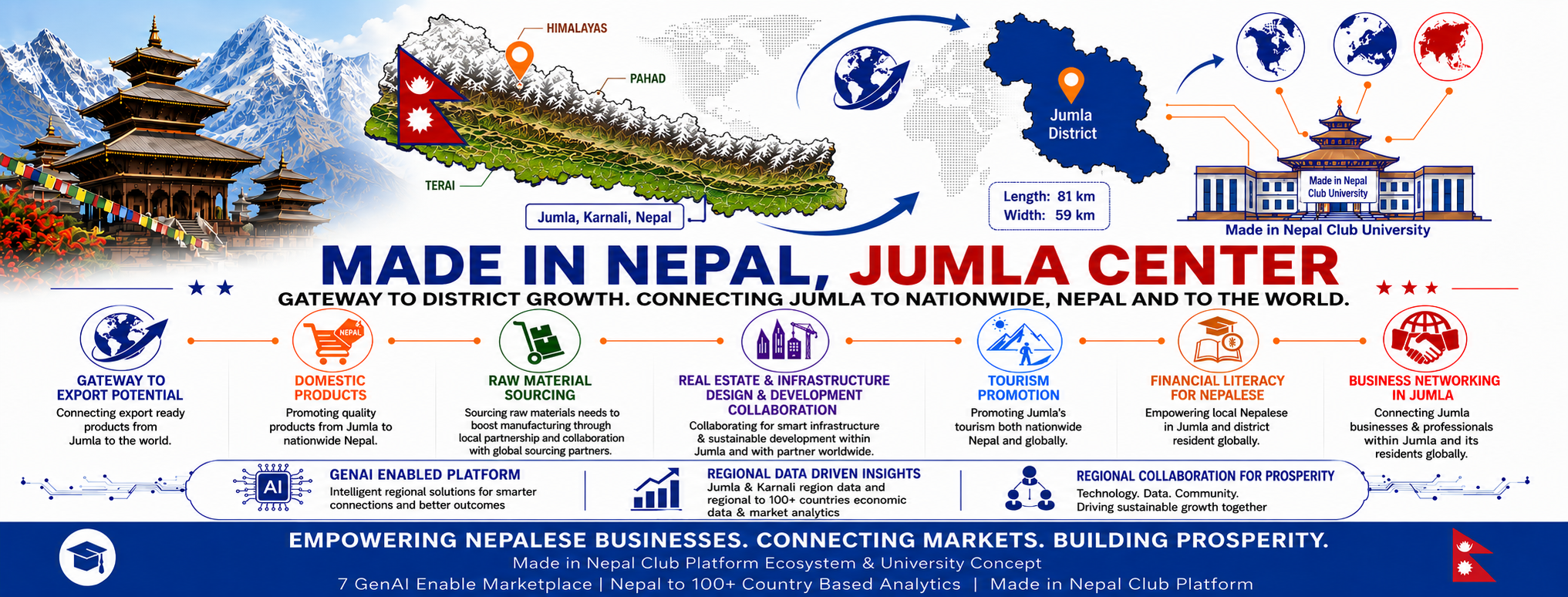
Gateway to Jumla, Nepal and the World
Export potential, domestic product promotion, raw-material sourcing, real estate and infrastructure collaboration, tourism promotion, financial literacy for Nepalese, and business networking across Jumla, nationwide Nepal and international markets.
Jumla opportunity case
Jumla has 118,349 residents across 2,531 square kilometres, or about 47 people per square kilometre, according to Nepal's 2021 census. Its eight local levels comprise Chandannath Municipality and seven rural municipalities. Jumla Khalanga is the administrative, trading, education and service hub, giving the district a practical base for aggregation and business support that can reach both rural producers and national markets.[1][2][3]
Jumla's strongest product proposition is a high-altitude origin portfolio: Jumli Marsi rice, apples, beans, buckwheat, potatoes, walnuts, honey, herbs and selected livestock or wool products. The National Agriculture Genetic Resources Center identifies Jumli Marsi as a distinct local genetic resource. The commercial priority is to protect authenticity while improving grading, storage, milling, packaging, food-safety compliance, traceability and coordinated sales.[4][5][12]
Tourism can link heritage, pilgrimage, food and landscape into a year-round district identity. Chandannath is an established pilgrimage site; Sinja Valley appears on Nepal's World Heritage Tentative List and carries exceptional Khasa history and linguistic significance; and Nepal Tourism Board presents Jumla as a trekking approach to Rara. Tatopani, Patarasi landscapes, village stays, apple orchards and Marsi food experiences can extend visitor stay when heritage safeguards and community benefit rules are built in from the start.[6][7][8][9]
Jumla has road and air access, but distance, weather, slope instability and seasonal disruption still affect cost and reliability. The Department of Roads maintains a Jumla division, while Jumla Airport provides a second access channel. Commercial promises should therefore use route-specific freight quotations, buffer inventory, cold-chain monitoring and realistic delivery windows rather than assuming uniform year-round logistics.[10][11]
Seven-platform market research and feasibility agenda
Global Market Access and Export Potential
Build verified lots for Marsi rice, apples and other priority products; validate buyers before scale; prepare HS-code, origin, quarantine, food-safety, packaging and logistics pathways; use QR-linked producer and batch records.
exportfromnepal.visitjumla.comDomestic Product Promotion
Create a trusted Jumla marketplace for Nepal's cities, institutions, hospitality buyers and diaspora; aggregate seasonal supply; run pre-orders; publish grade, harvest, dispatch, storage and freight information.
hamrosaman.visitjumla.comRaw Material Sourcing and Made in Nepal Production
Connect farmers and cooperatives with millers, packers, food brands and processors; prioritize packhouses, cold storage, drying, grading, milling and packaging while protecting seed, origin and organic claims.
formadeinnepal.visitjumla.comTourism Promotion
Package Chandannath pilgrimage, Sinja heritage, Jumla–Rara trekking, Tatopani wellness, Patarasi landscapes, orchard visits and food experiences with verified seasons, guides, safety, transport and community standards.
visithimalpahadterai.visitjumla.comReal Estate and Infrastructure Collaboration
Prepare investible concepts for packhouses, cold chain, warehouses, market yards, visitor facilities, sanitation, trails, renewable energy and digital connectivity. Require title, cadastral, heritage, zoning and environmental checks.
egharjagga.visitjumla.comFinancial Literacy for Nepalese
Deliver NRB-aligned modules on seasonal cash flow, savings, responsible credit, insurance, digital payments, fraud prevention, remittance use, pricing and small-business record keeping.
finguru.visitjumla.comBusiness Networking and Partnerships
Link the municipality and seven rural municipalities with producer groups, tourism operators, research institutions, regulators, logistics firms, banks, diaspora professionals, buyers and investors through a verified network.
connectingnepali.visitjumla.comCommercial model and indicative 12-month pilot budget
Use a blended model: public and development partners support shared data, community skills and common-use infrastructure; enterprises pay only for optional fulfilment, promotion, documentation, training or transaction services; sponsors and diaspora partners support defined campaigns. The Center should never promise buyers, approvals, credit or investment returns.
Planning conversion: USD 1 = NPR 153.19, using Nepal Rastra Bank's selling rate shown for 14 September 2026. USD amounts are rounded, and every contract should use the transaction-date rate.[13]
| Workstream | NPR | USD | Purpose |
|---|---|---|---|
| Global market and export readiness | NPR 7,000,000 | USD 45,695 | Product mapping, buyer tests, export compliance and logistics |
| Domestic product promotion | NPR 8,000,000 | USD 52,223 | Marketplace content, campaigns, pre-orders and fulfilment trials |
| Aggregation and primary processing | NPR 12,000,000 | USD 78,334 | Packhouses, cold-chain workflow, grading, milling and packaging pilots |
| Infrastructure and technology collaboration | NPR 10,000,000 | USD 65,278 | Pre-feasibility, prototypes, digital systems and common facilities |
| Tourism product and safety readiness | NPR 8,000,000 | USD 52,223 | Itineraries, operator skills, safety, sanitation and promotion |
| Financial literacy and enterprise coaching | NPR 3,000,000 | USD 19,584 | NRB-aligned learning and loan-readiness support |
| Networking, governance and monitoring | NPR 4,000,000 | USD 26,111 | Partnerships, inclusion, complaints and measurement |
| Indicative pilot total | NPR 52,000,000 | USD 339,448 | Release in evidence-based tranches |
Scope: This is a validation and operating pilot, excluding highways, airports, hydropower, major hotels, land acquisition and other large capital works. All amounts are planning assumptions, not quotations or funding commitments.
Twelve-month delivery plan
Form a district steering group; map enterprises, product volumes, tourism operators and infrastructure gaps across all eight local levels; verify Marsi and apple value chains; establish data, inclusion, heritage and environmental safeguards.
Select 30 to 40 test enterprises; prepare 15 to 20 priority products and six to eight tourism itineraries; validate buyers, storage and freight economics; train operators on quality, digital safety, pricing and records.
Run domestic and diaspora pre-orders, institutional buyer samples and destination campaigns; test packhouse and cold-chain workflows; publish a screened infrastructure shortlist; track fulfilment, complaints and local benefit.
Scale only offers meeting authenticity, demand, margin, reliability and compliance gates; independently review results; approve a three-year plan with matched finance, local ownership and quantified heritage and environmental safeguards.
Success measures, risks and recommendation
Year-one management targets: at least 200 verified enterprises or producer groups profiled; 75 traceable product listings; 15 qualified buyer or processor conversations; 10 bookable tourism products; 600 participants completing financial or enterprise learning; and 25 screened infrastructure concepts. These targets are for management and do not represent forecasts.
Principal risks: post-harvest loss, diluted or false Marsi origin claims, crop disease and climate shocks, road or aviation disruption, inconsistent quality, food-safety failure, land-title error, damage to heritage settings, seasonal tourism, digital fraud and unequal benefit capture. Controls should include producer and lot traceability, seed and origin protocols, testing, cold-chain logs, verified titles and permits, heritage review, community consent, grievance channels and public performance reporting.[12]
Recommendation: proceed with a 90-day validation phase led from Jumla, with national and international partners serving as channels rather than owners. Release the full NPR 52,000,000 (USD 339,448) pilot only in tranches tied to verified participation, authentic origin records, buyer validation, compliance readiness, storage and logistics tests, and heritage safeguards. Judge success by reliable transactions, lower post-harvest loss, value retained locally, visitor quality, access to finance and trusted partnerships—not website traffic alone.
Research references
- National Statistics Office — National Population and Housing Census 2021
- National Statistics Office — Jumla District Profile
- Chandannath Municipality
- National Agriculture Genetic Resources Center — Jumli Marsi
- Ministry of Agriculture — Statistics Information 2081/82
- Nepal Tourism Board — Chandannath, Jumla
- Nepal Tourism Board — Rara National Park and Jumla approach
- UNESCO World Heritage Centre — Sinja Valley
- Department of Archaeology — Nepal tentative heritage sites
- Department of Roads — Jumla Division
- Civil Aviation Authority of Nepal — Jumla Airport profile
- Department of Food Technology and Quality Control — NeFFILS
- Nepal Rastra Bank — Daily foreign exchange rates
- Nepal Rastra Bank — Financial Literacy Framework 2022
- Trade and Export Promotion Centre — Export Procedures
- Department of Industry — Industry registration guidance
- Department of Land Management and Archive
- Karnali Province — Resilient High Value Agricultural Programme
Method and limitation. This is a strategic pre-feasibility study based on published sources and platform-design assumptions. It is not engineering, legal, environmental, land-valuation, investment or credit advice. Field verification, stakeholder consultation, buyer testing and formal approvals are required before implementation.
बजार अनुसन्धान तथा पूर्वसम्भाव्यता रणनीति
जुम्लादेखि नेपाल र विश्व बजारसम्मको प्रवेशद्वार
जुम्लाभित्र, नेपालभरि र अन्तर्राष्ट्रिय बजारमा निर्यात सम्भावना, स्वदेशी उत्पादन प्रवर्द्धन, कच्चा पदार्थ स्रोत व्यवस्थापन, घरजग्गा तथा पूर्वाधार सहकार्य, पर्यटन प्रवर्द्धन, नेपालीका लागि वित्तीय साक्षरता र व्यावसायिक सञ्जाल।
जुम्लाको अवसर
नेपालको २०७८ जनगणनाअनुसार जुम्लामा २,५३१ वर्ग किलोमिटरमा ११८,३४९ मानिस बसोबास गर्छन्, अर्थात् प्रतिवर्ग किलोमिटर करिब ४७ जना। आठ स्थानीय तहमा चन्दननाथ नगरपालिका र सात गाउँपालिका छन्। जुम्ला खलङ्गा प्रशासन, व्यापार, शिक्षा र सेवाको केन्द्र भएकाले ग्रामीण उत्पादकलाई राष्ट्रिय बजारसँग जोड्ने संकलन तथा व्यवसाय सहयोगको व्यावहारिक आधार बन्न सक्छ।[१][२][३]
जुम्लाको प्रमुख उत्पादन प्रस्ताव उच्च पहाडी उत्पत्तिमा आधारित छ: जुम्ली मार्सी चामल, स्याउ, सिमी, फापर, आलु, ओखर, मह, जडीबुटी तथा चुनिएका पशु वा ऊनजन्य उत्पादन। राष्ट्रिय कृषि आनुवंशिक स्रोत केन्द्रले जुम्ली मार्सीलाई विशिष्ट स्थानीय आनुवंशिक स्रोतका रूपमा पहिचान गरेको छ। व्यावसायिक प्राथमिकता यसको प्रामाणिकता जोगाउँदै ग्रेडिङ, भण्डारण, मिलिङ, प्याकेजिङ, खाद्य-सुरक्षा अनुपालन, स्रोत पहिचान र संयुक्त बिक्री सुधार्नु हो।[४][५][१२]
पर्यटनले सम्पदा, तीर्थ, खाना र भू-दृश्यलाई वर्षभरि चिनिने जिल्ला पहिचानमा जोड्न सक्छ। चन्दननाथ स्थापित तीर्थस्थल हो; सिंजा उपत्यका नेपालको विश्व सम्पदा सम्भावित सूचीमा छ र खस इतिहास तथा भाषाका दृष्टिले विशिष्ट महत्त्व राख्छ; नेपाल पर्यटन बोर्डले जुम्लालाई रारा पुग्ने पदयात्रा मार्गका रूपमा प्रस्तुत गरेको छ। तातोपानी, पातारासीका भू-दृश्य, गाउँबास, स्याउ बगैँचा र मार्सी भोजन अनुभवले सम्पदा संरक्षण तथा स्थानीय लाभका नियमसहित पर्यटक बसाइ लम्ब्याउन सक्छन्।[६][७][८][९]
जुम्लामा सडक र हवाई पहुँच दुवै भए पनि दूरी, मौसम, भिरालो भूभाग र मौसमी अवरोधले लागत तथा विश्वसनीयतालाई असर गर्छ। सडक विभागको जुम्ला डिभिजन छ र जुम्ला विमानस्थल वैकल्पिक पहुँच माध्यम हो। त्यसैले व्यापारिक प्रतिबद्धता सबै मौसममा समान ढुवानी हुने मान्यतामा होइन, मार्गअनुसारको भाडा उद्धरण, जगेडा मौज्दात, शीतशृङ्खला अनुगमन र यथार्थ डेलिभरी अवधिमा आधारित हुनुपर्छ।[१०][११]
सात प्लेटफर्मको बजार अनुसन्धान तथा सम्भाव्यता कार्यसूची
विश्व बजार पहुँच तथा निर्यात सम्भावना
मार्सी चामल, स्याउ र अन्य प्राथमिक उत्पादनका प्रमाणित लट बनाउने; विस्तारअघि खरिदकर्ता परीक्षण गर्ने; एचएस कोड, उत्पत्ति, क्वारेन्टाइन, खाद्य सुरक्षा, प्याकेजिङ र ढुवानी मार्ग तयार गर्ने; उत्पादक तथा ब्याचको क्यूआर अभिलेख राख्ने।
exportfromnepal.visitjumla.comस्वदेशी उत्पादन प्रवर्द्धन
नेपालका सहर, संस्था, आतिथ्य खरिदकर्ता र प्रवासी समुदायका लागि विश्वसनीय जुम्ला बजार बनाउने; मौसमी आपूर्ति एकीकृत गर्ने; अग्रिम अर्डर सञ्चालन गर्ने; ग्रेड, बाली समय, पठाउने अवधि, भण्डारण र ढुवानी जानकारी प्रकाशित गर्ने।
hamrosaman.visitjumla.comकच्चा पदार्थ स्रोत तथा मेड इन नेपाल उत्पादन
किसान र सहकारीलाई मिल, प्याकर, खाद्य ब्रान्ड तथा प्रशोधकसँग जोड्ने; बीउ, उत्पत्ति र अर्गानिक दाबी जोगाउँदै प्याकहाउस, शीतभण्डार, सुकाइ, ग्रेडिङ, मिलिङ र प्याकेजिङलाई प्राथमिकता दिने।
formadeinnepal.visitjumla.comपर्यटन प्रवर्द्धन
चन्दननाथ तीर्थ, सिंजा सम्पदा, जुम्ला–रारा पदयात्रा, तातोपानी स्वास्थ्य अनुभव, पातारासी भू-दृश्य, बगैँचा भ्रमण र स्थानीय भोजनलाई प्रमाणित मौसम, गाइड, सुरक्षा, यातायात र सामुदायिक मापदण्डसहित प्याकेज गर्ने।
visithimalpahadterai.visitjumla.comघरजग्गा तथा पूर्वाधार सहकार्य
प्याकहाउस, शीतशृङ्खला, गोदाम, बजार केन्द्र, पर्यटक सुविधा, सरसफाइ, पदमार्ग, नवीकरणीय ऊर्जा र डिजिटल पहुँचका लगानीयोग्य अवधारणा बनाउने। स्वामित्व, नापी, सम्पदा, क्षेत्रगत र वातावरणीय जाँच अनिवार्य गर्ने।
egharjagga.visitjumla.comनेपालीका लागि वित्तीय साक्षरता
नेपाल राष्ट्र बैंकको ढाँचाअनुरूप मौसमी नगद प्रवाह, बचत, जिम्मेवार कर्जा, बीमा, डिजिटल भुक्तानी, ठगी रोकथाम, विप्रेषणको सदुपयोग, मूल्य निर्धारण र व्यवसाय अभिलेख तालिम।
finguru.visitjumla.comव्यावसायिक सञ्जाल तथा साझेदारी
नगरपालिका र सात गाउँपालिकालाई उत्पादक समूह, पर्यटन व्यवसायी, अनुसन्धान संस्था, नियामक, ढुवानी कम्पनी, बैंक, प्रवासी विज्ञ, खरिदकर्ता र लगानीकर्तासँग प्रमाणित सञ्जालमार्फत जोड्ने।
connectingnepali.visitjumla.comव्यावसायिक ढाँचा तथा १२ महिनाको संकेतात्मक पाइलट बजेट
मिश्रित ढाँचा अपनाउनुपर्छ: सरकारी तथा विकास साझेदारबाट साझा तथ्याङ्क, सामुदायिक सीप र साझा पूर्वाधार; उद्यमबाट वैकल्पिक ढुवानी, प्रवर्द्धन, कागजात, तालिम वा कारोबार सेवाको शुल्क; र प्रायोजक तथा प्रवासी साझेदारबाट स्पष्ट उद्देश्यका अभियान। सेन्टरले खरिदकर्ता, स्वीकृति, कर्जा वा लगानी प्रतिफलको ग्यारेन्टी गर्नु हुँदैन।
योजना रूपान्तरण दर: १४ सेप्टेम्बर २०२६ मा नेपाल राष्ट्र बैंकले देखाएको बिक्री दरअनुसार १ अमेरिकी डलर = नेरु १५३.१९। डलर रकम नजिकको पूर्ण अङ्कमा गोल गरिएको छ; सम्झौतामा कारोबार मितिको दर प्रयोग गर्नुपर्छ।[१३]
| कार्यधारा | नेपाली रुपैयाँ | अमेरिकी डलर | उद्देश्य |
|---|---|---|---|
| विश्व बजार तथा निर्यात तयारी | नेरु ७,०००,००० | अमेरिकी डलर ४५,६९५ | उत्पादन नक्साङ्कन, खरिदकर्ता परीक्षण, अनुपालन र ढुवानी |
| स्वदेशी उत्पादन प्रवर्द्धन | नेरु ८,०००,००० | अमेरिकी डलर ५२,२२३ | बजार सामग्री, अभियान, अग्रिम अर्डर र आपूर्ति परीक्षण |
| संकलन तथा प्रारम्भिक प्रशोधन | नेरु १२,०००,००० | अमेरिकी डलर ७८,३३४ | प्याकहाउस, शीतशृङ्खला, ग्रेडिङ, मिलिङ र प्याकेजिङ परीक्षण |
| पूर्वाधार तथा प्रविधि सहकार्य | नेरु १०,०००,००० | अमेरिकी डलर ६५,२७८ | पूर्वसम्भाव्यता, नमुना, डिजिटल प्रणाली र साझा सुविधा |
| पर्यटन उत्पादन तथा सुरक्षा तयारी | नेरु ८,०००,००० | अमेरिकी डलर ५२,२२३ | यात्रा प्याकेज, सीप, सुरक्षा, सरसफाइ र प्रवर्द्धन |
| वित्तीय साक्षरता तथा उद्यम परामर्श | नेरु ३,०००,००० | अमेरिकी डलर १९,५८४ | राष्ट्र बैंकअनुरूप शिक्षा र कर्जा तयारी |
| सञ्जाल, सुशासन तथा अनुगमन | नेरु ४,०००,००० | अमेरिकी डलर २६,१११ | साझेदारी, समावेशिता, गुनासो र मापन |
| संकेतात्मक पाइलट जम्मा | नेरु ५२,०००,००० | अमेरिकी डलर ३३९,४४८ | प्रमाणका आधारमा किस्तामा निकासा |
सीमा: यो प्रमाणीकरण तथा सञ्चालन पाइलट हो। राजमार्ग, विमानस्थल, जलविद्युत्, ठूला होटल, जग्गा खरिद र अन्य ठूला पूँजीगत आयोजना यसमा समावेश छैनन्। सबै रकम योजना अनुमान हुन्, कोटेशन वा लगानी प्रतिबद्धता होइनन्।
१२ महिनाको कार्यान्वयन योजना
जिल्लास्तरीय सञ्चालन समूह गठन; आठै स्थानीय तहका उद्यम, उत्पादन परिमाण, पर्यटन व्यवसायी र पूर्वाधार कमीको नक्साङ्कन; मार्सी र स्याउ मूल्य शृङ्खला प्रमाणीकरण; तथ्याङ्क, समावेशिता, सम्पदा र वातावरणीय सुरक्षा व्यवस्था।
३०–४० परीक्षण उद्यम छनोट; १५–२० प्राथमिक उत्पादन र ६–८ पर्यटन प्याकेज तयार; खरिदकर्ता, भण्डारण र ढुवानी अर्थशास्त्र परीक्षण; गुणस्तर, डिजिटल सुरक्षा, मूल्य निर्धारण र अभिलेख तालिम।
स्वदेशी तथा प्रवासी अग्रिम अर्डर, संस्थागत खरिदकर्ता नमुना र गन्तव्य अभियान; प्याकहाउस तथा शीतशृङ्खला कार्यप्रवाह परीक्षण; छानिएको पूर्वाधार सूची प्रकाशन; आपूर्ति, गुनासो र स्थानीय लाभ अनुगमन।
प्रामाणिकता, माग, मार्जिन, विश्वसनीयता र अनुपालन परीक्षा पार गरेका प्रस्ताव मात्र विस्तार; स्वतन्त्र समीक्षा; सह-वित्त, स्थानीय स्वामित्व तथा मापनयोग्य सम्पदा र वातावरणीय सुरक्षासहित तीन वर्षे योजना।
सफलता मापन, जोखिम र सिफारिस
पहिलो वर्षका व्यवस्थापन लक्ष्य: कम्तीमा २०० प्रमाणित उद्यम वा उत्पादक समूह प्रोफाइल; स्रोत पहिचानसहित ७५ उत्पादन सूची; १५ योग्य खरिदकर्ता वा प्रशोधक संवाद; १० बुक गर्न मिल्ने पर्यटन उत्पादन; वित्तीय वा उद्यम शिक्षा पूरा गर्ने ६०० सहभागी; र २५ प्रारम्भिक रूपमा छानिएका पूर्वाधार अवधारणा। यी व्यवस्थापन लक्ष्य हुन्, पूर्वानुमान होइनन्।
मुख्य जोखिम: बालीपछिको नोक्सानी, कमजोर वा नक्कली मार्सी उत्पत्ति दाबी, बाली रोग र जलवायु आघात, सडक वा हवाई अवरोध, असमान गुणस्तर, खाद्य सुरक्षा असफलता, जग्गा स्वामित्व त्रुटि, सम्पदा क्षेत्रमा क्षति, मौसमी पर्यटन, डिजिटल ठगी र लाभमा असमान कब्जा। नियन्त्रणमा उत्पादक तथा लट स्रोत पहिचान, बीउ र उत्पत्ति कार्यविधि, परीक्षण, शीतशृङ्खला अभिलेख, प्रमाणित स्वामित्व र अनुमति, सम्पदा समीक्षा, सामुदायिक सहमति, गुनासो प्रणाली र सार्वजनिक प्रगति प्रतिवेदन समावेश गर्नुपर्छ।[१२]
सिफारिस: जुम्लाको नेतृत्वमा ९० दिने प्रमाणीकरण चरण सुरु गर्ने र राष्ट्रिय तथा अन्तर्राष्ट्रिय साझेदारलाई मालिक होइन, बजार माध्यम बनाउने। नेरु ५२,०००,००० (अमेरिकी डलर ३३९,४४८) को पूर्ण पाइलट बजेट सहभागिता, प्रामाणिक उत्पत्ति अभिलेख, खरिदकर्ता परीक्षण, अनुपालन तयारी, भण्डारण तथा ढुवानी परीक्षा र सम्पदा सुरक्षासँग बाँधिएका किस्तामा मात्र निकासा गर्ने। वेबसाइट ट्राफिकभन्दा भरपर्दो कारोबार, कम बालीपछिको नोक्सानी, जिल्लामा रहेको मूल्य, पर्यटक अनुभवको गुणस्तर, वित्तीय पहुँच र विश्वसनीय साझेदारी मापन गर्नुपर्छ।
अनुसन्धान सन्दर्भ
- राष्ट्रिय तथ्याङ्क कार्यालय — राष्ट्रिय जनसंख्या तथा आवास जनगणना २०७८
- राष्ट्रिय तथ्याङ्क कार्यालय — जुम्ला जिल्ला प्रोफाइल
- चन्दननाथ नगरपालिका
- राष्ट्रिय कृषि आनुवंशिक स्रोत केन्द्र — जुम्ली मार्सी
- कृषि तथा पशुपन्छी विकास मन्त्रालय — कृषि तथ्याङ्क २०८१/८२
- नेपाल पर्यटन बोर्ड — चन्दननाथ, जुम्ला
- नेपाल पर्यटन बोर्ड — रारा राष्ट्रिय निकुञ्ज तथा जुम्ला मार्ग
- युनेस्को विश्व सम्पदा केन्द्र — सिंजा उपत्यका
- पुरातत्त्व विभाग — नेपालको सम्भावित विश्व सम्पदा सूची
- सडक विभाग — जुम्ला डिभिजन
- नेपाल नागरिक उड्डयन प्राधिकरण — जुम्ला विमानस्थल प्रोफाइल
- खाद्य प्रविधि तथा गुण नियन्त्रण विभाग — NeFFILS
- नेपाल राष्ट्र बैंक — दैनिक विदेशी विनिमय दर
- नेपाल राष्ट्र बैंक — वित्तीय साक्षरता ढाँचा २०२२
- व्यापार तथा निकासी प्रवर्द्धन केन्द्र — निर्यात प्रक्रिया
- उद्योग विभाग — उद्योग दर्ता मार्गदर्शन
- भूमि व्यवस्थापन तथा अभिलेख विभाग
- कर्णाली प्रदेश — उत्थानशील उच्च मूल्य कृषि कार्यक्रम
विधि तथा सीमा। यो प्रकाशित स्रोत र प्लेटफर्म डिजाइन मान्यतामा आधारित रणनीतिक पूर्वसम्भाव्यता अध्ययन हो। यो इन्जिनियरिङ, कानुनी, वातावरणीय, जग्गा मूल्याङ्कन, लगानी वा कर्जा सल्लाह होइन। कार्यान्वयनअघि स्थलगत प्रमाणीकरण, सरोकारवाला परामर्श, खरिदकर्ता परीक्षण र औपचारिक स्वीकृति आवश्यक छन्।